Google Address Autocomplete - Prestashop
Autocomplete addresses at checkout with Google Places API. Fills street, city, zip code, state and country in one…
- PS 1.7+
- PS 8
- PS 9
You do not sell to a German the way you sell to a Turk. This module detects the visitor's country and serves your shop in their language, in their currency and with the price list you decided for that market, from the very first page they open. No cloned stores, no risk to your rankings. For PrestaShop 1.7.6 up to 9.x.
With a single price you have to choose: set the one your strongest market bears and stay out of the rest, or set the lowest one and give away margin where people would have paid more. PrestaShop already stores a different price per currency; what it cannot do is put every visitor into the currency that belongs to them before they see the first figure, and keep the other price lists out of sight. That is what this module does.
You set the rupee price that makes sense in India and the euro price that makes sense in Germany. Someone browsing from Mumbai sees rupees from the home page, without touching a thing. Someone browsing from Berlin sees euros and is never offered the Indian list: their country selector only shows the currencies you enabled for them.

The prices stay where you already keep them: in PrestaShop's specific price per currency. The module does not invent a parallel price table for you to maintain; it takes care of what the core does not, which is deciding the currency each visitor walks in with.
From the Cloudflare header or from MaxMind's GeoLite2 database on your own server. No paid services and no third-party calls on every visit.
Each rule sets the currency the visitor arrives in and which other currencies they may pick. Anything outside their rule is never even offered.
The visitor lands on the URL of their own language. If they were already heading to a language URL, that one is respected: it is what they asked for.
Every language keeps its own indexable URL and crawlers stay out of the redirect: Google keeps seeing the page it has indexed.
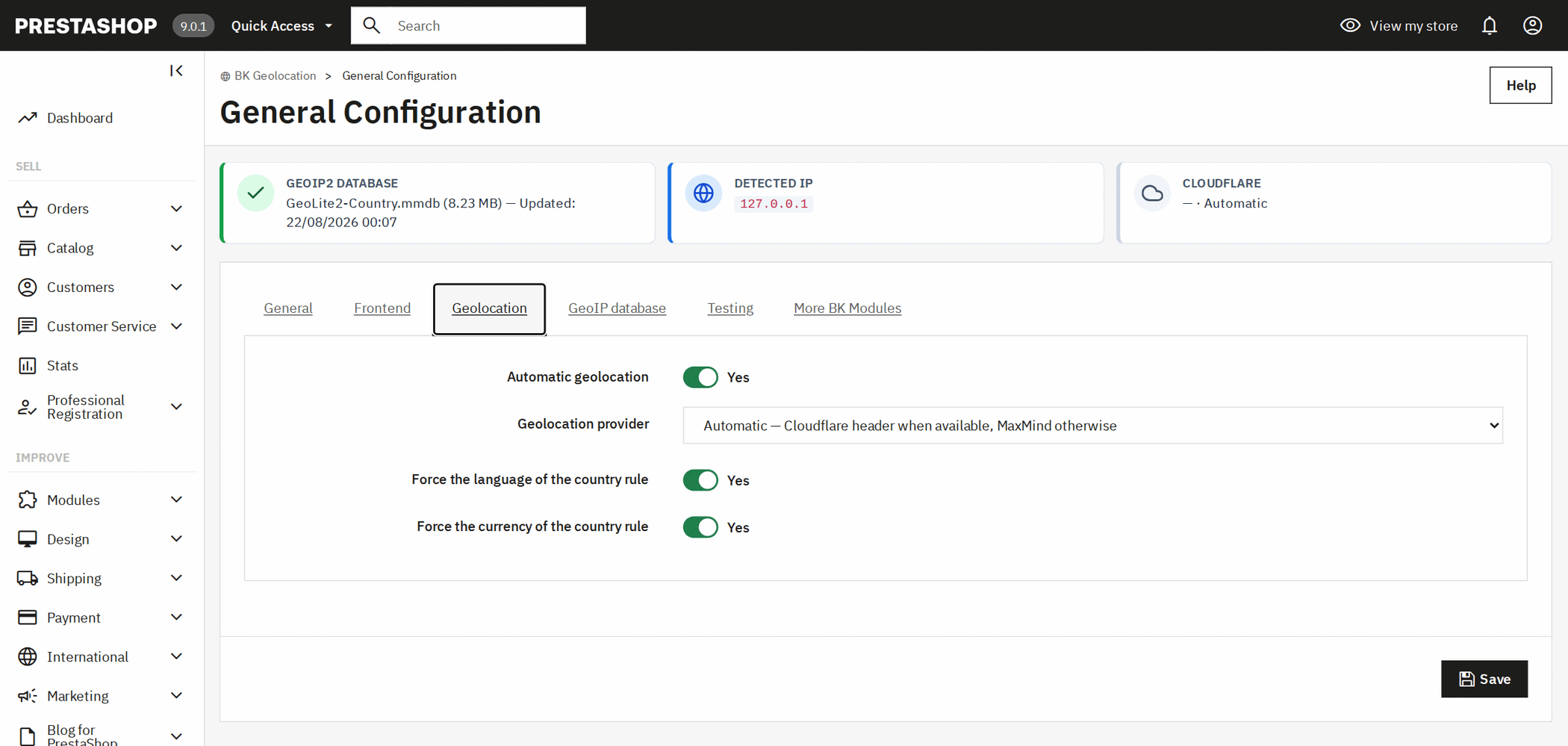
Modal, dropdown, side drawer or compact button, in any of the fifteen positions of your theme. With a search box and country names written in their own language.
Every shop in the installation keeps its own rules and its own exceptions, with nothing bleeding across.
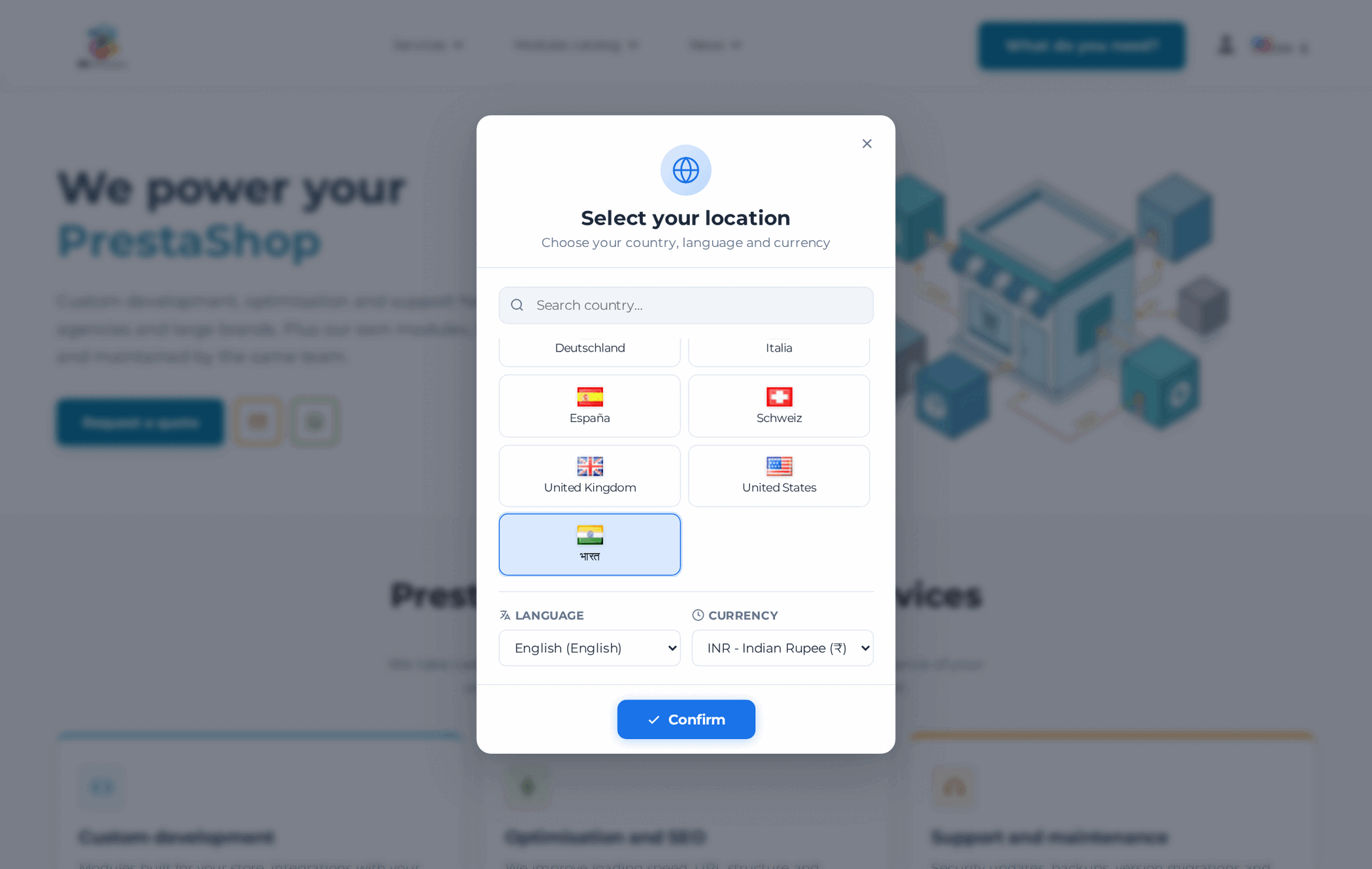
Deutschland, España, Italia, भारत. Country names are not translated into the language of the page: they are written in each country's main language, which is how the people who live there recognise them. Underneath, the language and currency for that country, already selected; and a search box that understands both names, so typing "Germany" finds "Deutschland".

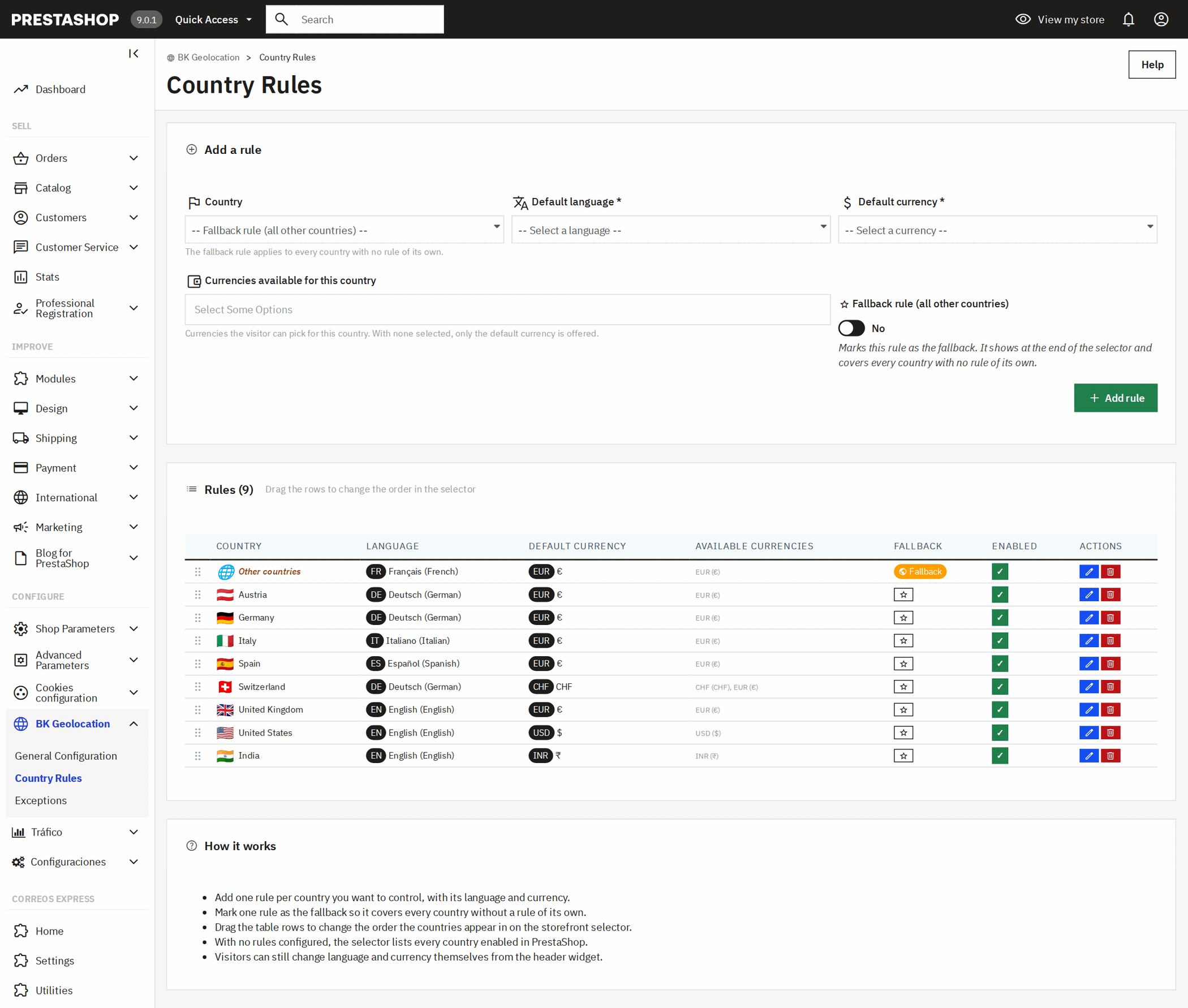
On install it reads the languages you have enabled and creates one rule for each with its matching currency, plus a fallback rule for the rest of the world. It works from minute one; you refine it from there.
One row per country: language, entry currency and the currencies it may switch to. Drag them to set their order in the selector, or disable one without deleting it.
On the product page, a specific price per currency. That is all: the module already makes sure every visitor arrives in the right one.

This is where most international shops come undone: serving different content on the same URL depending on who is asking. This module is built the other way round.

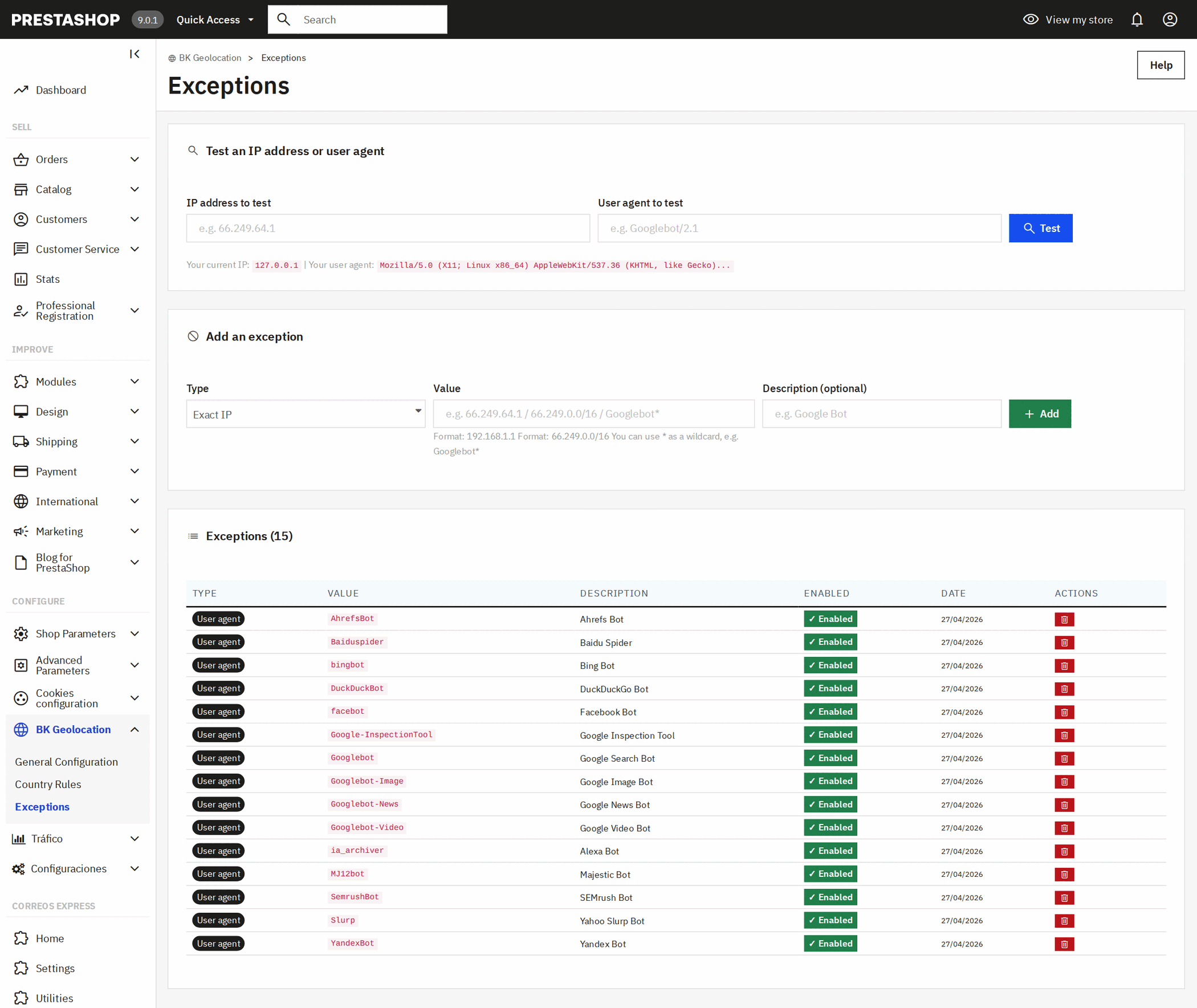
The bot list ships ready — Google, Bing, Yandex, the usual SEO tools — and takes any other user agent or IP address: handy as well for letting your agency or your team browse the shop without being geolocated.
If your shop sits behind Cloudflare, the country already arrives in the header of every request: no lookups, no maintenance. If it does not, the module resolves it with MaxMind's GeoLite2 database installed on your own server. On automatic it uses the header when it arrives and the database when it does not.

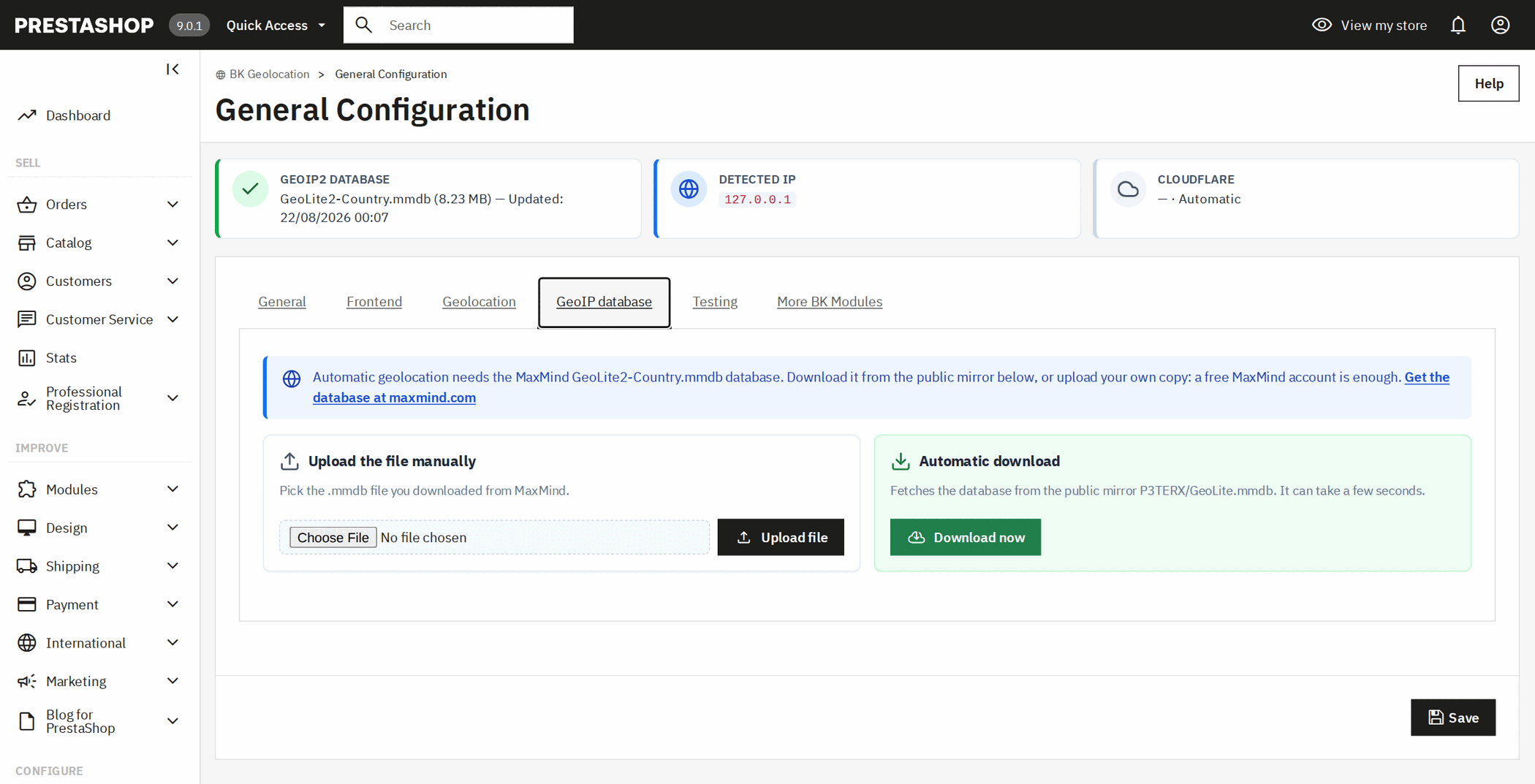
One button downloads the GeoLite2 database from a public mirror and installs it. If you would rather use your own, a free MaxMind account is enough to download it and upload it from the same screen. The panel shows the file size and date, and warns you when it has gone stale.

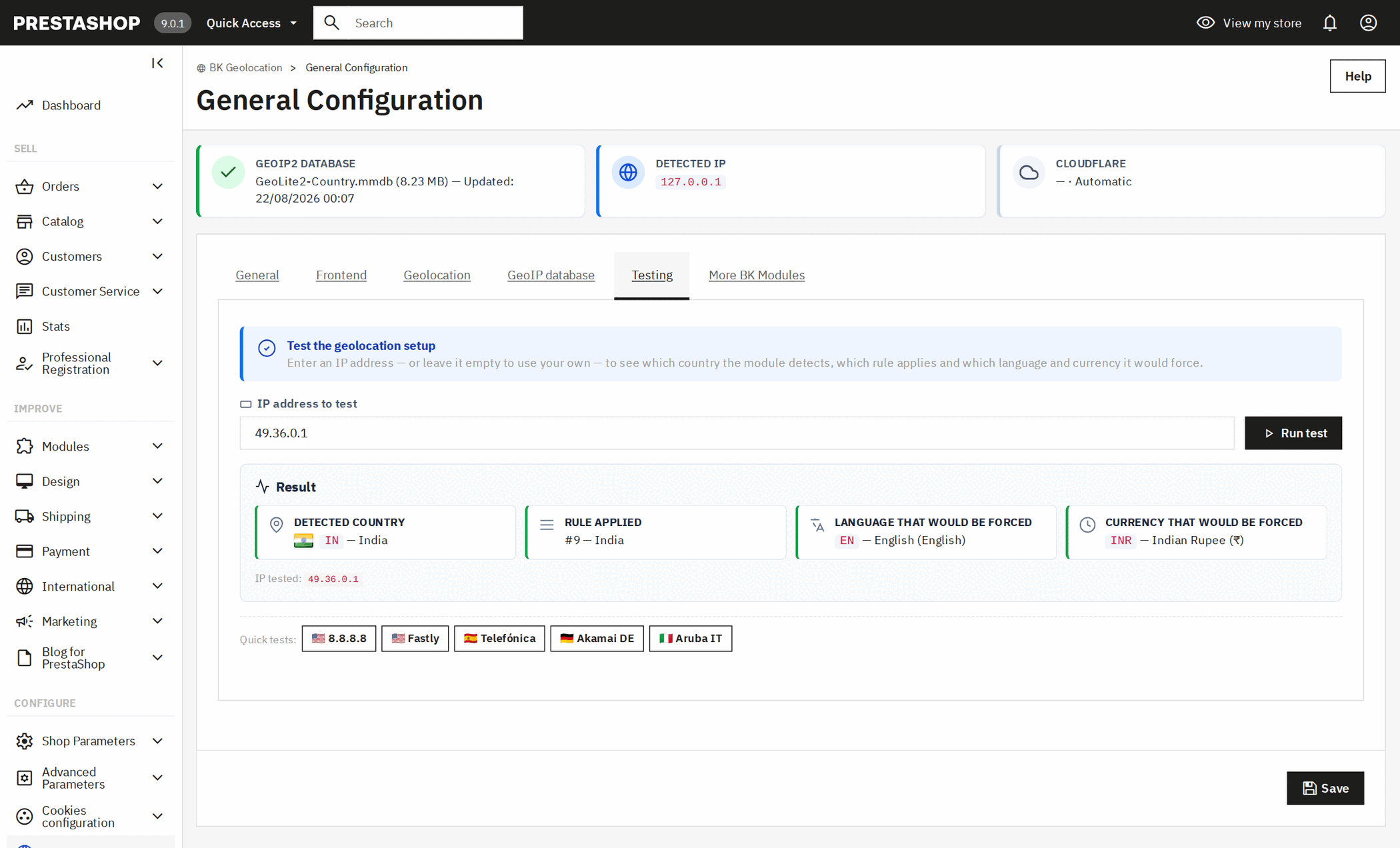
Type an IP address from any country and the module tells you which country it detects, which rule applies, and the language and currency that visitor would arrive with. With shortcuts for known addresses in several countries.

Purchasing power in India, Brazil or Turkey is not the German one. A price list per currency gets you into markets that would never buy at your European price, without dropping it for everyone.
A price in the customer's own currency converts better than one converted on the fly: nothing to translate in your head, no exchange rate to distrust.
Visitors land straight in their language instead of on a home page they cannot read, and search engines still see a clean site with one URL per language.
Each country comes in with the currency and the terms of its region, and the other currencies never show up in the selector.
Yes, with a specific price per currency on each product or combination. What PrestaShop will not do on its own is put the visitor into their country's currency: that is this module's job, and it is why the two together give you a price list per market.
By creating a rule for that country with its currency. From then on anyone browsing from there sees the shop in that currency without touching anything, and the selector only offers the currencies you marked as available for their country.
It does when it is done badly: by changing the content of a URL depending on who asks. Here every language keeps its URL, search engines are excluded from the redirect, and for them the currency follows the language of the URL, so they always index the same page with the same prices.
No. You can download the GeoLite2 database with the module's button, no account required. And if your shop runs behind Cloudflare you need no database at all: the country arrives in the request header.
They can pick one in the selector. Their choice is stored in a cookie — for as many days as you decide — and it overrides geolocation for as long as it lasts: whoever chooses, chooses.
Yes. It is tested from PrestaShop 1.7.6 to 9.x, on PHP 7.1 to 8.4 and on multistore installations.
No. The selector hooks into one of PrestaShop's fifteen standard positions and you pick it in the settings. It overrides no theme template and no core file.
The shop goes back to behaving as it did, and your rules, exceptions and settings stay stored in case you reinstall or move servers. They are only wiped if you press the button that does exactly that.

Ready to boost your PrestaShop store? Let's discuss your project and create something amazing together.
Contact us now